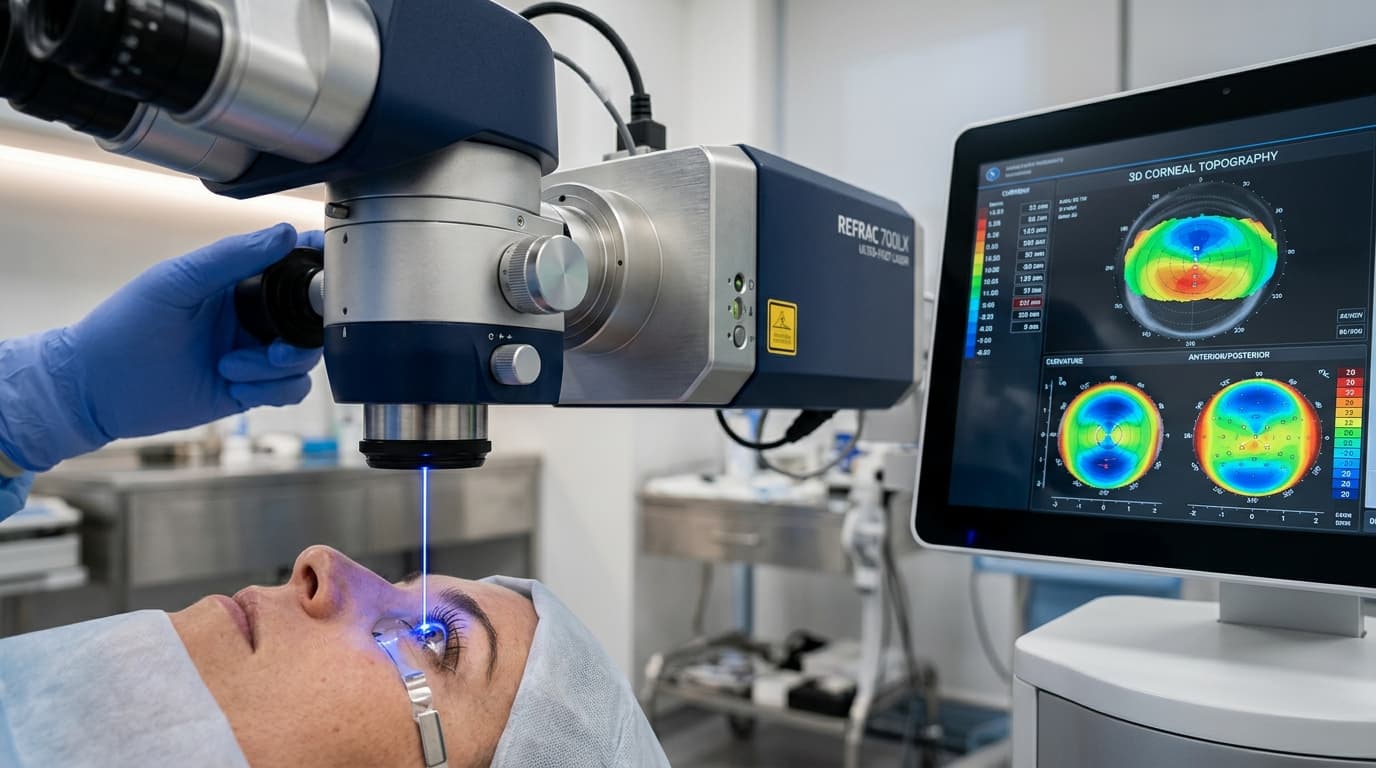
- Femto-LASIK offers same-day visual recovery with virtually zero post-operative discomfort.
- PRK is safer for patients with thinner corneas or active contact-sport lifestyles.
- A dilated eye exam and corneal topography scan are essential before determining suitability.
- Both procedures deliver permanent refractive correction with over 98% patient satisfaction.
Watch this procedural demonstration to understand modern micro-surgical precision and recovery outcomes.
For millions of adults wearing prescription glasses or contact lenses, modern refractive surgery offers the life-changing opportunity to wake up with natural, crystal-clear 20/20 sight. However, when patients visit The Eyes clinic at 162-A Shah Jamal in Lahore, their most common question is: 'Should I choose Femto-LASIK or PRK?' Both techniques utilize high-precision excimer lasers to reshape the cornea, but their surgical approaches suit different corneal anatomies.
What is Blade-Free Femto-LASIK?
Femto-LASIK is the global gold standard in laser vision correction. In this two-step procedure, a femtosecond laser creates an ultra-thin, microscopic flap in the outer corneal tissue without any surgical blade. The surgeon gently folds back the flap, and an excimer laser reshapes the underlying corneal bed in mere seconds.
Once reshaping is complete, the flap is repositioned without stitches and adheres naturally within minutes. Patients experience virtually no pain, and visual recovery is remarkably rapid — most patients achieve functional 20/20 vision by the following morning.
What is PRK (Photorefractive Keratectomy)?
PRK is the original laser vision correction procedure that remains vital for specific patients. Unlike LASIK, PRK does not involve creating a corneal flap. Instead, the surface epithelial cells of the cornea are gently removed, and the excimer laser applies correction directly to the corneal surface.
A soft therapeutic bandage contact lens is placed over the eye while the surface layer naturally regenerates over 3 to 5 days. While visual recovery is gradual compared to LASIK, PRK preserves maximum corneal tissue and eliminates flap-related complications altogether.
Key Factors in Determining Your Suitability
1. Corneal Thickness: Candidates with naturally thin corneas are better suited for PRK because it preserves greater residual corneal bed depth.
2. Lifestyle & Profession: Individuals engaged in contact sports, martial arts, law enforcement, or armed forces often benefit from PRK because there is no flap that could be dislodged by direct ocular trauma.
3. High Myopia (Extreme Nearsightedness): Patients requiring higher corrections may be evaluated for Femto-LASIK or Phakic IOLs depending on corneal curvature.
4. Dry Eye Predisposition: Patients with pre-existing dry eye symptoms may be advised PRK or specialized surface treatment to preserve corneal nerve sensitivity.
The Diagnostic Protocol at The Eyes Clinic
At The Eyes, no laser procedure is performed without comprehensive corneal topography, pachymetry (corneal thickness mapping), and wavefront aberration analysis. Conducted at our 162-A Shah Jamal facility, these advanced scans allow our senior fellowship consultants to tailor an exact treatment plan to your unique ocular anatomy.
Medical Conclusion
Both Femto-LASIK and PRK boast success rates exceeding 98% in restoring spectacle independence. The ideal choice depends on your corneal structure, lifestyle, and diagnostic scans. Schedule an in-person corneal assessment with Dr. Ahmad Hussain at The Eyes to discover your optimal path to clear sight.

Dr. Ahmad Hussain
Senior consultant eye surgeon with over 35 years of clinical and microsurgical experience in Lahore. Senior member of The Eyes clinical founding team at 162-A Shah Jamal.
Questions About Your Eye Health?
Book an in-person diagnostic examination with our senior consultant team at 162-A Shah Jamal, Lahore.